Jesus Christ Archive

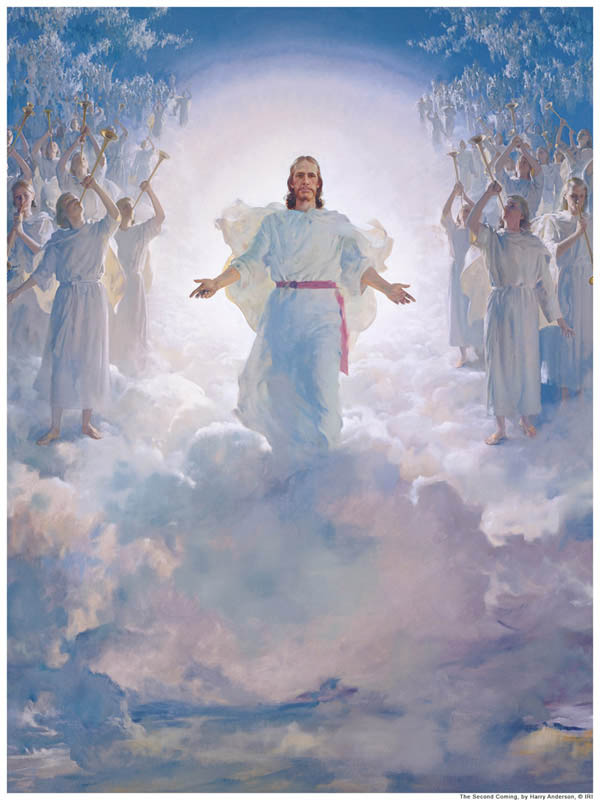
Members of The Church of Jesus Christ of Latter-day Saints, who are often called Mormons by others, believe that Jesus Christ will return to earth one day. Mormons focus on what we know about that time and leave the rest to God.
Jesus Christ will return to Earth.
“Four matters are indisputable to Latter-day Saints: (1) The Savior will return to the earth in power and great glory to reign personally during a millennium of righteousness and peace. (2) At the time of His coming there will be a destruction of the wicked and a resurrection of the righteous. (3) No one knows the time of His coming, but (4) the faithful are taught to study the signs of it and to be prepared for it. (See Dallin H. Oaks, “Preparation for the Second Coming,” Liahona, May 2004, 7–10)
Let’s look first at the first and second principles Elder Oaks mentioned. Mormons believe in the Second Coming. We can over cover what will happen briefly in this article. For a more detailed explanation, read the chapter on... Read the rest of this entry »

The media has spent a lot of time on the Book of Mormon Musical, a Broadway production people either love or hate. The reviews have often demonstrated the biases of the reviewers. One rejoiced that the musical showed that religion believes in a lot of silly things (not just Mormonism, but all religion). Another suggested the message was that blind faith is a sin, with his unspoken message being that religious faith is always blind. A Jewish writer argued that Jewish people, with their great knowledge of the dangers of religious persecution, should speak out loudly against the musical. Other writers have noted that the musical attacks all religions, even though it focused on only one. Some have noticed it is an inherently vicious portrayal of Africans, mocking their poverty and suffering.
The official statement of The Church of Jesus Christ of Latter-day Saints was a single sentence:
“The production may attempt to entertain audiences for an evening, but the Book of Mormon as a volume of... Read the rest of this entry »

When people talk about Mormonism, they often focus in on small things that are not important, aren’t taught currently, aren’t even practiced today. By doing so they miss an opportunity to understand Mormonism as it lives today and even as it was originally taught.
To understand Mormonism, you must focus on core doctrines, those things which are canonized as official doctrine and taught consistently. While church practices sometimes change, truth does not.
There are a few guidelines that can help you evaluate whether or not a teaching is a core doctrine—or even a true doctrine of Mormonism.
First, it is important to understand that every word spoken by a prophet is not necessarily doctrine, particularly in the earliest days of the church. In the beginnings, the church was run much more informally. People talked among themselves and sometimes others took notes and published those conversations or informal speculations of church leaders.
The Journal of Discourses is the usual source... Read the rest of this entry »

This year, Mormon Sunday School classes for adults and teens and the Senior Primary children who are ages eight to twelve are studying the New Testament. All Primary children—those ages 3 to 11, will have a sharing time (a time when a number of classes meet together to be taught by their leaders) focusing on the truthfulness of scripture.
The Sunday School classes and senior Primary are on a four year rotation system. Each year they study one book of scripture—Old Testament, New Testament, Book of Mormon and Church History/Doctrine and Covenants (a book of modern revelation). The Senior Primary, the teens, and the adults study the same book of scripture at the same pace but at their own level. This allows families to come together after church and during the week to discuss what they’ve learned and lets parents reinforce those teachings.
Younger children, ages four to seven, are on a two year rotation, covering two books of scripture in one year, with an emphasis on the life of Christ... Read the rest of this entry »

Mormon beliefs sometimes get confused with the beliefs and practices of other religions. One such belief concerns the celebration of Christmas. Mormons tend to be very passionate Christmas celebrators, with many Mormon congregations hosting nativity festivals or free sing-alongs of Handel’s Messiah each year.
While Santa makes an appearance in some Mormon homes, the focus is always on the meaning of Christmas. Christmas is considered a sacred holiday and Mormon families are encouraged to simplify the secular portions of it in order to make more room for the spiritual elements of the Christmas celebration.
Mormons believe in the divinity of Jesus Christ and celebrate His birth as a pivotal moment in eternal life. The Book of Mormon, which Mormons consider a companion book to the Bible, says, “And we talk of Christ, we rejoice in Christ, we preach of Christ, we prophesy of Christ, and we write according to our prophecies, that our children may know to what source they may look for a... Read the rest of this entry »
Every year, Temple Square in Salt Lake City, Utah is a popular destination for tourists and locals alike, but especially so at Christmas time. It is decorated for Christmas with millions of lights, nativities, and special religious programming designed to help us remember that Christmas is a Christian holiday.
A Temple Square Christmas celebration is one that is taken seriously and prepared for many months in advance. Staff begins putting out the cables and extension cords in August, quickly followed by thousands of strands of lights. Volunteers and workers hang garland and lanterns and set up nativities throughout the grounds in November in order to be ready the Friday after Thanksgiving. For many, decorating the Square is a family tradition. Read the rest of this entry »
Bookmark on Delicious Digg this post Recommend on Facebook share via Reddit Share with Stumblers Tweet about it Read More →

In the October 2010 General Conference, a semi-annual world-wide meeting for Mormons, Boyd K. Packer gave a talk which generated some controversy. It has been widely reported as a talk on homosexuality, but was in reality a talk on a proclamation on families issued by the Mormons a number of years ago. In this talk, he also addressed pornography, honoring marriage vows, and chastity. He focused on the ability of people to choose repentance and then to succeed in their sincere efforts to repent and their ability to be forgiven for past sins.
In order to understand why the controversy is misguided, one must understand some important principles concerning how the Mormon Church operates. Elder Packer is an apostle. The president of the Church and the prophet are roles both filled by Thomas S. Monson. President Monson is assisted by two counselors. He and the counselors form the First Presidency of the Church. Next is the Quorum of the Twelve Apostles, of which Elder Packer is the president.... Read the rest of this entry »

A soft-launch of the newly revised LDS.org is available for preview at NewLDS.org. Not all features are working, but you can easily see what will soon be available for you to use. It is a far more personalized and interactive site than the previous version.
To use the personalized features, you will need to register. You’ll only be asked for a username and password, and if you are LDS (Mormon) for your membership record number. The membership number allows you to access the few parts open only to members—membership lists for your own ward or stake (similar to congregations and dioceses) and to information specifically for people in certain callings or programs. Although you must register, you will not be contacted by missionaries or other church members. In the years I’ve been registered, I’ve never even received an email from them. It simply allows them to provide you with private access to any personalized materials you create and to ensure no one accesses portions of the site... Read the rest of this entry »
The Church of Jesus Christ of Latter-day Saints, whose members are sometimes called Mormons, recently issued the following statement:
In the mid-19th century, when rhetorical, emotional oratory was common, some church members and leaders used strong language that included notions of people making restitution for their sins by giving up their own lives.
However, so-called “blood atonement,” by which individuals would be required to shed their own blood to pay for their sins, is not a doctrine of The Church of Jesus Christ of Latter-day Saints. We believe in and teach the infinite and all-encompassing atonement of Jesus Christ, which makes forgiveness of sin and salvation possible for all people.” (See Mormon Church Statement on Blood Atonement.) Read the rest of this entry »
Bookmark on Delicious Digg this post Recommend on Facebook share via Reddit Share with Stumblers Tweet about it Read More →
In the strictest sense, the word exmormon simply refers to someone who chose to end his membership in the Church of Jesus Christ of Latter-day Saints. Members of the Church are sometimes referred to informally as Mormons, and so an ex-mormon is a former Mormon. However, the term is more commonly used to refer not to people who simply left and moved on, but to those who then devote themselves to attacking the church.
Read the rest of this entry »
Bookmark on Delicious Digg this post Recommend on Facebook share via Reddit Share with Stumblers Tweet about it Read More →