Posts Tagged ‘Are Mormons Christian’

Free Online Videos About Jesus Christ

Monday, December 5th, 2011

On December 5,2011, The Church of Jesus Christ of Latter-day Saints, whose members are sometimes called Mormons, announced a new website devoted to free online videos about Jesus Christ. The first videos are now available and teach the Christmas story in the exact words of the King James Bible.

Mormon videos on the birth of Jesus Christ include the wise men.The project is the first of many films to be produced on a film set near Goshen, Utah. 830 acres have been turned into a replica of ancient Jerusalem and other New Testament locations. It is not a re-creation of the city of Jerusalem. It is a collection of settings that can be used and re-used for the needed scenes. Digital imaging will create some aspects of the city, such as the temple, that are not being built. Researchers went to Jerusalem, studied it, and photographed it. They also studied the scriptures to understand how things needed to look. The goal was to create as authentic a set as possible. Months of searching finally led them to a large piece of land that included sand dunes, desert, and even a river. The mountains in the background looked appropriately Biblical.

The set was designed to be highly efficient. Columns and windows are interchangeable so they can be altered to fit the time period needed, since future films may cover other scriptural times. Draining the pool of Bethesda, where Jesus healed a man who was lame, and covering it, allows them to use the same space to film the wedding at Cana.

The project will create thirty brief scenes from the New Testament to be used in classes, at church visitor’s centers, and online. The initial project focuses on the life of Jesus Christ and of His apostles.

Currently on the site are videos about Mary learning from an angel that she is to become the mother of Jesus Christ, a scene of Mary and Elisabeth talking about their miracles, the journey of Mary and Joseph to Bethlehem, the shepherds coming to worship the baby, the presentation of Jesus at the temple, and the later arrival of the Wise Men, who did not arrive until Jesus was a toddler. A mobile app is available, and one for I-Phone is coming soon.

Mormons worship Jesus Christ as their Savior. The Book of Mormon, which the Mormons use along with the Bible, says, “And we talk of Christ, we rejoice in Christ, we preach of Christ, we prophesy of Christ, and we write according to our prophecies, that our children may know to what source they may look for a remission of their sins” (2 Ne. 25:26). Mormons teach that only through Jesus Christ can we be saved and receive the gift of eternal life.

Mormon beliefs teach that Jesus Christ was born the son of Mary, who was a virgin at the time of His birth, and of God. They do not claim any understanding of how the conception occurred, despite gossip to the contrary. They do believe it was done in a way that was respectful of Mary and that God, not the Holy Ghost, is the Father of Jesus Christ.

Mormon beliefs teach that Jesus Christ is the only Begotten Son of Jesus Christ and that He was baptized despite having no sin of which to repent. In the Garden of Gethsemane, Jesus Christ voluntarily took on Himself the sins of the world, a very personal and individual gift to all of us, one that brought powerful suffering and yet is often overlooked by the Christian world. He died on the cross and was resurrected in three days. Through this act, He broke the bonds of death.

Jesus’ atoning sacrifice allowed all mankind to be resurrected, to live forever, and to repent of their sins. It also allowed them to activate the gift of eternal salvation if they chose to do so, by accepting Jesus Christ as their Savior, being baptized, and keeping the commandments. However, everyone receives the great gift of grace, since all are resurrected regardless of their acts. Eternal life, however, is a choice each person must make. The Bible tells us that just saying we believe in Jesus Christ is not enough; to be saved we must keep the commandments.

“Not every one that saith unto me, Lord, Lord, shall enter into the kingdom of heaven; but he that doeth the will of my Father which is in heaven” (Matthew 7:21).”

Mormons worship Jesus Christ in their weekly worship services, in their Mormon temples, and in their everyday lives. Little children are taught a song called, “I’m Trying to Be Like Jesus” and in their classes, they learn how Jesus lived and are taught to emulate Him. This continues into adulthood and is an eternal goal for Mormons.

The new website is part of a continuing effort of the Mormons to help the world come to know Jesus Christ.

Visit the website: The Life of Jesus Christ Bible Videos. There is no charge and you do not need to register to view them.

Watch a sample video:

What are the Core Doctrines of Mormonism

Wednesday, March 9th, 2011

When people talk about Mormonism, they often focus in on small things that are not important, aren’t taught currently, aren’t even practiced today. By doing so they miss an opportunity to understand Mormonism as it lives today and even as it was originally taught.

Mormonism centers on the atonement of Christ

To understand Mormonism, you must focus on core doctrines, those things which are canonized as official doctrine and taught consistently. While church practices sometimes change, truth does not.

There are a few guidelines that can help you evaluate whether or not a teaching is a core doctrine—or even a true doctrine of Mormonism.

First, it is important to understand that every word spoken by a prophet is not necessarily doctrine, particularly in the earliest days of the church. In the beginnings, the church was run much more informally. People talked among themselves and sometimes others took notes and published those conversations or informal speculations of church leaders.

The Journal of Discourses is the usual source for speculations by people of other religions. Journal of Discourses is not an official church publication and is not used as a source of official doctrine. It was compiled by people who took notes of speeches, prayers, sermons, and other events in shorthand and then transcribed them. However, not all the transcriptions were accurate. None were evaluated by or approved by church leaders as being official pronouncements of doctrine. It was privately published in England to provide income for the owner of the journals, although Brigham Young approved the project as a way for European Mormons to find out what was going on in Utah. It was basically the equivalent of a newspaper. Today, the Mormons own Deseret News, but articles that appear in the newspaper are not considered official doctrine, and neither are articles in the Journal of Discourses. With the availability of modern technology, many errors have been officially documented.

Because the church was small, even in General Conference, today a very formal event, people were free to ask questions. Because Mormonism focuses on continuing revelation and learning “line upon line” much of the doctrine was not yet known. Therefore, leaders sometimes speculated about possible answers. These speculations did not become doctrine unless Brigham Young or other prophets prayed and received confirmation of the truthfulness of the doctrine. Otherwise, it was just personal opinion and even a prophet is allowed to have an opinion.

So how does one know if something is an official doctrine? Both official Mormon websites, Mormon.org (intended for people who are not LDS) and LDS.org (aimed more toward Mormons but open to anyone) contain official statements of doctrine. Look for official announcements there.

It is important to remember that not all doctrine is given equal weight or importance in Mormonism. It is also important to remember that in a church that does not refuse to allow God to continue to speak and to lead, doctrine is given in increasing steps, what Mormons call learning line upon line. This means Mormons have, over the years, been given doctrine suitable just for one time period or doctrine that might be considered beginner doctrine. As the church membership grew and people became more informed about the gospel, God gradually added to their knowledge. An easy way to understand how this works is to read the lesson manuals written for children. Although the same subject might be covered in each age group, older children are given more complex information because they are ready for it. Mormons are taught by God in increasingly sophisticated stages.

Joseph Smith outlined thirteen Articles of Faith that explained the core beliefs of Mormonism at that time. These are still taught and even memorized by children. Reading them can help earnest students of Mormonism, those determined to learn only what is true about Mormons, to recognize core doctrine. The first Article of Faith is the very core of Mormonism:

“We believe in God the eternal Father, in His Son, Jesus Christ, and in the Holy Ghost.”

This creates a foundation on which all other doctrines are based. The first Article of Faith makes possible the fourth, which succinctly summarizes the core of Mormonism:

“We believe that the first principles and ordinances of the Gospel are: first, Faith in the Lord Jesus Christ; second, Repentance; third, Baptism by immersion for the remission of sins; fourth, Laying on of hands for the gift of the Holy Ghost.”

Faith in Jesus Christ is critical to the mission and doctrine of Mormon beliefs. Repentance, the second portion of this article of faith, refers to Mormon belief in the atonement of Jesus Christ and the importance of both grace and repentance in the process of living a Christian lifestyle. Baptism, performed after the manner in which Jesus was baptized, allows people to be forgiven of their sins and is a result of grace, which came to us through the atonement. The Holy Ghost was a gift Jesus Himself promised to send to His followers once He was gone.

Another principle of Mormonism is that of continuing revelation. Nowhere does the Bible state that once Jesus died, God would no longer be willing to communicate with His children or to send them prophets. While the apostles lived, they received revelation and guidance from God and functioned as apostles, seers, and revelators. Once they died, God did withdraw for a time, an event known as an apostasy. It is not that God is not willing to have prophets on the earth at any given time, but mortals are not always willing to accept and honor prophets. When this happens, they are the ones who remove the gift of prophecy from the earth. This happened frequently throughout the Bible and happened for the longest period of time after the apostles died.

However, the Bible assures us that God will do nothing except through his prophets. (See Amos 3:7.) This means that in order to prepare us for the return of Jesus Christ, another core doctrine of Mormonism, God must restore prophets to the earth. He did this when He chose Joseph Smith as His first prophet in the last days. Today, the Church is led by Thomas S. Monson, the Mormon prophet.

There is no question as to the need for a prophet in today’s world. A short drive around most towns will show a large number of churches, all with conflicting doctrine. Clearly, original doctrine has been corrupted over time—this process started even during the New Testament times, leaving the apostles to regularly fight to overcome misunderstandings in doctrine. Without a prophet, no man can do any more than just guess at what God wants of us today or of what specific doctrines mean. Modern-day revelation is key to giving people a fair chance to prepare for the Second Coming.

Another core doctrine of Mormonism is family life. Mormon beliefs include strong teachings on the sacredness of the family unit. Families were planned by God to help Him further His work on earth and are one reason we came to earth. Mormons teach that God’s plan for families today are that families consist of one mother and one father and are meant to last forever. Mormons can be married in a Mormon temple and have their marriages “sealed” for time and all eternity. This means they do not get a divorce at death, but continue the marriage forever if they live worthy of God’s greatest blessings. In addition, parents and children are joined together forever, something most people instinctively understand, even if they say they don’t believe it. Listening to comments at a funeral often reveal a deep belief in eternal families. (“Mom and Dad are together again.”)

Central to Mormon doctrine is the Plan of Salvation. It is the story of our eternal life and unifies the most important teachings of the Mormons.

Our stories began when God created our spirits. We lived with Him as spirits for a very long time, learning truth, learning to love God, and deciding what kind of person we wanted to be. Eventually, as is the case with children living at home, we could progress no further without leaving home and going out “into the world, one God and Jesus would prepare for us. He explained that when we went there we would lose our memory of our time with Him because this journey was about faith. However, we would gain bodies and families and the Spirit of Christ would go with us to help us recognize truth if we wanted to find it.

During our time here we would face trials—different trials for each person—and we could choose our responses to them. Agency was, in fact, key to the experience. Our choices would, as Mormon prophet Thomas Monson likes to say, determine our destiny. However, we could not choose the consequences of those actions.

God knew we would all sin, and He wanted to make it possible for us to return to Him even when we did sin. He loves us and wants us all to make it back home. For this reason, He promised to send a Savior who would live on earth for a time, teach the gospel, and take our sins on Himself, saving us through grace. This grace would allow us to rise from the dead, repent, and make it back to God if we kept the commandments. Grace cannot be bought—we do not have, in ourselves, the power to bring about resurrection or forgiveness. However, the Bible is very clear that only those who keep the commandments and who repent of sins will be allowed to return to God.

“Not every one that saith unto me, Lord, Lord, shall enter into the kingdom of heaven; but he that doeth the will of my Father which is in heaven” (Matthew 7:21). The Bible warns us that faith without works is dead. If you say you believe and accept Jesus Christ as your Savior, you are saying only words unless obedience follows the words.

Some were unwilling to accept Jesus Christ as their Savior, preferring Satan’s unscriptural promise to save people without any risk of any kind. That meant we would also have no agency. We would simply be puppets of Satan and this would render life meaningless. One-third of the spirits chose to follow Satan and were denied the chance to come to earth. All those who were willing to make a commitment to Jesus were allowed to be born.

Life here on earth is not easy, but it is designed to allow us to have opportunities for growth. It allows us to seek out and find truth if at all possible.

But of course, it is not possible for everyone. Some people live their entire lives never having heard of Jesus Christ—some because they lived before He was born and some because the gospel simply never reached them. Over the centuries, theologians have debated what happens to those people. Would God unfairly punish them for something out of their control?

No, of course not. God is loving and fair and He sent us here. This means He will give everyone a fair chance to accept or reject His gospel. Those who die without being given that opportunity will receive it after their death—not a second chance, but a first chance, the only way a loving God would choose to do it. They can, just as we can, accept or reject Jesus Christ’s teachings and accept the blessings and consequences of their choice.

The Plan of Salvation is a kind, loving, and brilliant plan by our Heavenly Father, designed to give us an opportunity to become everything He intended us to become.

As you continue to study official church websites, take note of what Mormons are being currently taught in their classes. The lesson manuals are all openly online. Those teachings are the core. Mormons are impacted only by core doctrines—those taught by current prophets that affect our eternal salvation.

Mormons Studying New Testament in 2011

Wednesday, January 5th, 2011

This year, Mormon Sunday School classes for adults and teens and the Senior Primary children who are ages eight to twelve are studying the New Testament. All Primary children—those ages 3 to 11, will have a sharing time (a time when a number of classes meet together to be taught by their leaders) focusing on the truthfulness of scripture.

The Sunday School classes and senior Primary are on a four year rotation system. Each year they study one book of scripture—Old Testament, New Testament, Book of Mormon and Church History/Doctrine and Covenants (a book of modern revelation). The Senior Primary, the teens, and the adults study the same book of scripture at the same pace but at their own level. This allows families to come together after church and during the week to discuss what they’ve learned and lets parents reinforce those teachings.

Younger children, ages four to seven, are on a two year rotation, covering two books of scripture in one year, with an emphasis on the life of Christ as taught in the four gospels of the New Testament, and on the Book of Mormon. They repeat the manuals one time, but at a more grown up level. Nursery toddlers and three year olds have just one lesson manual which covers stories from all scriptures.

The Mormons are offering a solid collection of materials to help both Mormons and non-Mormons study the New Testament this year. The actual lesson manuals are available online, both the student and teacher’s editions. This allows curious non-Mormons to find out what Mormons actually teach their own members about Jesus Christ.

Read or listen to the Adult Sunday School (Gospel Doctrine) teacher’s manual for the New Testament.

Read or listen to the student study guide for adults on the New Testament.

Read the teacher’s manual for the children’s New Testament class. (The children don’t receive a manual.)

Many Mormons like a more in-depth study of the scriptures each year. Teenagers study a book of scripture each year in Seminary that does not match the Sunday School rotation. Seminary is held most weekdays, usually before the school day begins. It is a much more in-depth study of the New Testament and includes scripture memorization. The lesson manual for this class is also online for anyone who wants to use it.

Read the Seminary New Testament Manual online. You’ll note this page also has additional study materials, including music, a list of scriptures to memorize, a reading chart and a timeline.

For even more in-depth study, you might want to explore the Institute of Religion Manual. This manual is a college-level course and has a great deal of interpretation, inspiration, historic and cultural background information and more to help you really dig into your study of the New Testament.

Read the Institute of Religion New Testament manual.

While the Mormons have had the Bible free on the Internet for a long time, the new scripture site has some exciting additions to help people study the scriptures. For many of these features, you will need to sign up for an account. While reading the New Testament, which doesn’t require an account, you can also use account-based tools to write notes, keep a scripture-reading journal, highlight scriptures and even print out your work. You can even, without an account, download MP-3s of an audio New Testament. Mormons use the King James translation of the Bible.

This year the Mormons will be studying the life, ministry, and divinity of Jesus Christ. Why not take a peek and see what they will be learning?

Christmas at Temple Square

Monday, November 29th, 2010

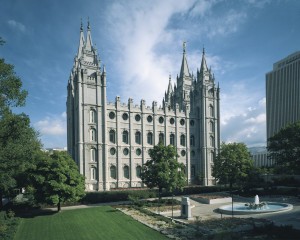
Every year, Temple Square in Salt Lake City, Utah is a popular destination for tourists and locals alike, but especially so at Christmas time. It is decorated for Christmas with millions of lights, nativities, and special religious programming designed to help us remember that Christmas is a Christian holiday.

A Temple Square Christmas celebration is one that is taken seriously and prepared for many months in advance. Staff begins putting out the cables and extension cords in August, quickly followed by thousands of strands of lights. Volunteers and workers hang garland and lanterns and set up nativities throughout the grounds in November in order to be ready the Friday after Thanksgiving. For many, decorating the Square is a family tradition. (more…)

Our Faith is Centered in Jesus Christ

Tuesday, August 18th, 2009

Recently, Elder Russell M. Ballard spoke to graduating students at Brigham Young University, a school owned by The Church of Jesus Christ of Latter-day Saints. Members of this church are often informally known as Mormons. He counseled them in ways to discuss their religion with others, pointing out

that most topics of greatest interest to detractors are not critical elements of the current religion, but are fringe elements or practices no longer carried out. He advised them to keep the discussions focused on the core of the religion, the elements that affect salvation, rather than those that are merely interesting intellectual discussion points. (more…)